Doing some literature research, I created a presentation on GDPR based on information of the European Commission. Using information from Microsoft, there is an overview on the impact of GDPR on its technology stack and the level of GDPR compliance.
In the digitalization race, companies struggle to correctly organize Document Management. Most of the time the struggle has to do with an inability to correctly identify what a document means in their business context, let alone define the management part of it and understand the difference with Record Management.
The goal of this article is to remove some of the confusion, to better define the roles of document and record management and to explain how these are related in managing the document life cycle.
The struggle has two main causes. First, the digitalization has turned documents from a paper carrier (physical form) into a digital equivalent. Companies fail to adapt and optimize their business processes. Most of time only the entry and exit activity are adapted: incoming paper documents are replaced by digital documents through scanning and outgoing digital documents are converted into a paper document through printing. An optimized business process should not care or be sensitive to the carrier but focus on the content or what is communicated within the document.
The content is the second cause. Companies struggle to distinguish Document Management from Record Management. The fact that both are intertwined enhances the confusion. Documents are used to carry business information in a way that it is consumable by people and systems. Records register business events to create evidence of a business activity. We often need documents to convey and exchange business events which makes things confusing.
What adds to the confusion is people seeing the physical document flow as an equivalent of the business flow and seeing the document as the synonym of the business event. Think for example about a purchase order. This happens because humans need business events being presented in an understandable way in order to interact with them. In business this is achieved through paper documents or, if things have evolved, electronic forms that represent structured data. Piling on top of the confusion, when the interaction is removed and the information is exchanged between systems, in an automated way without human intervention, business often keeps calling it the electronic document exchange. For example, a Purchase Order is called a document in Electronic Data Exchange. The confusion comes to an absolute high, when people understand that also unstructured data is communicated through documents. For example, the general conditions added along a Purchase Order
As shown below Record Management (RM) and Document Management (DM) have distinct characteristics but also a large area of joined characteristics. These are often combined into Data Management (DaM).
The disambiguation can start by saying that DM has an external focus i.e. how to communicate information between a company and its environment i.e. client, suppliers, government and other stakeholder. Whereas RM has an internal focus i.e. representing business events and storing these in and exchanging these between, Line of Business (LOB) systems. Mapping these concepts on a prototypical architecture diagram, the RM is mostly contained in what is depicted as the core services in the diagram and DM we can found in the satellite services around the core.
The exchange of data internally requires the introduction of another element of confusion. Systems that store business events are called Systems of Record. On the opposite site, there are the systems that use business events, these are called Systems of Reference. The organization and management of the data and data flows between Systems of Record and Systems of Reference is what Master Data Management (MDM) entails.
To link RM and DM, we created the following a high-level view on the Document Life Cycle as shown below.
This high-level view has a predominant DM focus. In the detailed view the interaction between DM and RM becomes clear as this shows the interaction points between DM and RM flow and activities. The RM related activities are encapsulated in the dashed rectangle and the interaction between DM and RM takes place in the Manage and Utilize phase of the document life cycle.
We have added a detailed explanation of all the phases and activities in the overview presentation you can download here:
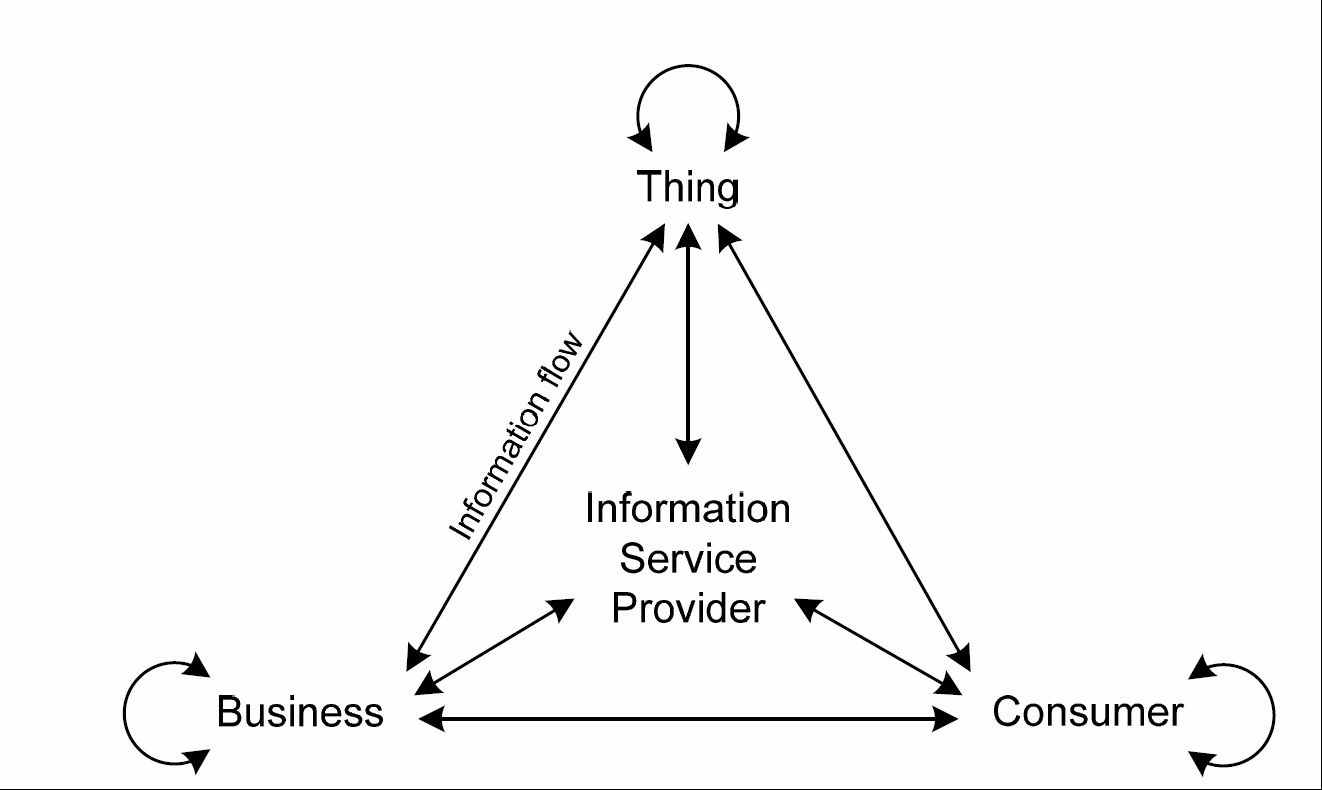
Some highlights from the “Architecting the Internet of Things” by Dieter Uckelmann et al.
IOT requires an open, scalable, secured and standardized infrastructure to allow for person to object and object to object communication. As the cost of infrastructure goes down the amount events that can be tracked through sensor data will increase resulting in deep immerging of technologies in our day to day live.
IOT evolved and is evolving:
Intranet of things
Extranet of things
Internet of things
Internet of things and people
How to create web 2.0 or the social web? It is al about sharing: sharing becomes the norm. The financial and non-financial incentives of sharing according to the laws of information:
Information can be shared with other without it losing its vale.
The value of information increases with it use. Unused information does not provide any value.
Information is perishable and the value decreasing over time.
The value of information increase with its accuracy.
The value of information increase with it is combined with other information.
More information is not necessary better. Relevant information is.
“Internet of Things (IoT) is an integrated part of future Internet and could be defined as a dynamic global network infrastructure with self-configuring capabilities based on standard and interoperable communication protocols where physical and virtual ‘things’ haveidentities, physical attributes, and virtual personalities and use intelligent interfaces, and are seamlessly integrated into the information network”
What is IoT NOT?
Ubiquitous passive computing: this does not require object or internet infra
IP: not linked to a specific protocol
Communication technology: IOT requires communication but it not prescribes how it must be done
Embedded device (like RFID): there must be a information infrastructure backend
Applications: combination of hardware and software
The internet of people: objects are an important aspect
Intranet or Extranet of Things: not limited to a small group of stakeholders (=closed-loop instead of open-loop)
In this presentation following topics are coffered
What is IoT?
What does IoT Architecture looks like?
What is Communications Platform as a Service (CPaaS)?
What is Intelligent Cloud and Intelligent Edge (Azure Edge)?
What is Open Platform Communication’s Unified Architecture (OPC-UA)?