Category Archives: Uncategorized

“How IT will change in the next 10 years and why should you care ?” Miha Kralj

[MS Techdays 2009] Summary “How IT will change in the next 10 years and why should you care ?” Miha Kralj

I added some personal interpretations!

Past successes can be your worst enemy!
IBM? cash cow, the mainframe, was replaced in a few decennia by new kids on the block forcing IBM going from hero to zero. Are IBM employee? really stupid people? I don? think so Šthey just didn? correctly anticipate the changing markets. So they were replaced by Microsoft, Oracle and Compact.

Not only IBM had a hard time to survive. In 1997 there were about 24 major system vendors: IBM, Nec, Olivetti, Tandem, Siemens ŠThis list was reduces to about 10 in 2004. In 2008 about 6 were left: HP, Dell, IBM, Fujitsu, Sun and Nec.

The connected world
The environment we work and live in has dramatically changed as well. Think about the fact that in most cases we are 5 up to 6 seconds away from any connected network be it a PC, phone, mobile phone ?/p>

Young graduates that just started working never experienced a world without technology. They are what we call Digital Natives. The digital world is the world as they know it and grew up in. On the other hand you have the Digital Immigrant. The once that experienced the introduction of the digital age and changes during their lifetime: the first PC, the first mobile phone ?/p>

Both groups, Digital Natives and Digital Immigrants, are using technology in a different way. Digital Immigrants like to know how stuff works and are very loyal to brands. Digital Natives have no brand attachment and don? care how thing work. It just should work, whether there is complex technology under the hood or not!

The three-screen-era is about to end: TV screen, computer monitor and mobile device. People want multi-purpose devices. Also different user experiences are finding their way to the consumer market. System accessing more than just  sight and hearing senses but also focusing on touch, gestures, motion, ?/p>

New Business Models
Servers are sold per container now! It this case literally a container delivered in your server room that just needs to be hooked up with a power cable, a network cable and a cooling line. You don? even get the key to open it!

Originally developed for disaster situations these containers found their way into normal operations. The idea behind this is, if nobody mingles with the servers inside there is a better change for optimal operations. Human error is more likely to cause havoc. They don? even sent over an engineer if 80% of the servers is up and running.

Changing business models often require a change in mindset as well. For example if you see a car as service that takes you from A to B, the brand of car becomes irrelevant. If you?e about to chose your new leasing car, everybody would disagree. On the other hand if you?e taking a taxi, you will never object to the brand. Then the car is just a means of transportation.

Sometimes in IT we still want to decide on car? brand while that might not be important. The Digital Natives would say: as long as it works, it? fine. In the older business models servers are looked upon as assets. In the container model they are just services bought from a vendor. The difference lays in the financing of both models. As assets huge pre-financing is required. As service we only have monthly bills to pay.

Servers became a commodity what is payed for on a monthly basis. Servers just work ?utomagically?i.e. automatically and transparent.

Cloud computing is going even further then the container model in outsourcing the hosting power completely. To force is into the new mindset, we must ask ourselves is hosting applications our core business?

Social Networks
The evolution from a consumer-provider based Web 1.0 model to the Web 2.0 model where everybody is consumer and provider at the same time has changed the way we say the internet.

Interesting reading material: The Wisdom of Crowds by James Surowiecki

What is needed for Web 2.0 to really take off, according to Kralj:

  • The virtualization must become even more realistic: so user interfaces with better look and feel.
  • Privacy and trust must be augmented: you?l leave a long digital trail if you buy something on the internet.
  • Intelligent search: If I? in Paris and looking for the Hilton Hotel, I don? want to see any search result about Ms. Paris Hilton escapades.
  • Meritocracy: merits can be earned anywhere, even in the digital world! If someone can lead a digital gang of 50 people in some on-line game and can gain respect of the gang in doing so, there should be no reasons why it can? be part of his resume and be reasons for hiring this guy as a project leader.

Globalization impacts everybody
Where is the world? largest English speaking community located?  The correct answer is in China! So the next time you come up with a marketing strategy  you might think twice.

Interesting reading material: The World is Flat by Thomas L. Friedman.

Looking Ahead
This changing world forces us to look ahead:

  • Tomorrow think about the next technology wave!
  • Next week review how these trends will affect your business!
  • Next month explore what your job will be the next 10 years!
Share this postSave this post

“Architectures: The Good, the bad and the ugly” Miha Kralj

 [MS Techday 2009] Summary “Architectures: The Good, the bad and the ugly” Miha Kralj

What is architecture?
Architecture is about models and all models are flawed but some are useful i.e. patterns & anti-patterns.

What about architects?
The arrogant Architects suffer from the McKinsey Syndrome:

  • We know it all, we don’t need to listen.
  • They don’t know what they really want.
  • Just a cookie-cutting redelivery.

How much architecture?
A rule of thumb says 1 page of functional requirements results in 4 pages of technical requirements.

Measuring results!
Measure results to avoid a softie-softie approach i.e. the project is finished when the customer is happy.

What about home-grown application?
Avoid them! The bosses?nephew has built something your boss likes so it must be installed as enterprise product.

What about scalability, security … ? If you don’t think about these things upfront they are a nightmare to add lather on.

Only the best is good enough!
The best-of-breed:

  • The best DB is from Oracle
  • The best directory is from Novel
  • The best distributed transaction manager is from IBM

The problem is how to get all those best-of-breeds to integrate?

The anti-pattern is vendor lock-in: buying everything from the same supplier.

Not invented here!
We can do it better syndrome. Maybe an out-of-the-box product is just good enough!

The anti-pattern is called the Golden Hammer. Use the same product in every occasion were it remotely seams applicable: just whack it with the same architecture.  We have created this nice enterprise library and now we going to use it everywhere.

Skills of an Architect
Skilled Architects are capable of dealing with ambiguity and uncertainty. They also require a good set of communication skills: listen & talk to peers, to engineers ?IT pro? ?Developers and to the higher hierarchy in an organization.

The Best Architecture versus The Right Architecture
The best architecture is a dream. It is better to be approximately right then working on the ultimate system that never gets delivered. The focus must be on implementable architecture and not a theoretic pleasing architecture. Focus on pragmatism. Architecture is simplicity not intellectual violence.

Wei & Wu Wei!
Uh, what ?!? Make and Not Make. Build something to specifications, nothing more nothing less. But also build something that can grow.

Middle-Out Architecture
This means a layered architecture following the hour-glass representation: a lot of possible uses on the top and a wide range of implementations at the bottom going through a minimalistic interface in the middle results in a timeless architecture.

If you look at some of the thriving business models of the last decennia, they all follow the middle-out architecture model. For example Amazon.Com: in the middle you have AWS or Amazon Web Services opening up access to everyone that wants to integrate with Amazon. Same for live.com with the live api sitting in the middle.

Strategic Thinking Think about why something is done and not only about how it can be done! Be architects and not only engineers! In the future architects can play 3 roles:

  • You can change the world!
  • You can watch the world changing!
  • You can wake up surprised that the world changed overnight!

Another summary you’ll find at https://community.dynamics.com/blogs/navigateintosuccess/comments/10162.aspx

Share this postSave this post

“Azure? A lap around Cloud-Hosted Services.” Ingo Rammer

[MS Techdays 2009] Summary “Azure? A lap around Cloud-Hosted Services.” Ingo Rammer

What is the cloud about?
Currently we have desktop and server OS’s optimized for single machines and a bit of clustering. Once you leave the safe grounds of this one machine, support for transparently consuming resources somewhere in the cloud deteriorates very quickly.

Cloud applications are about:

  • Large-scale failover capabilities
  • Geographic dispersion (multi-country)
  • Deployment support
  • Patch Management
  • Capacity Management and large-scale clustering

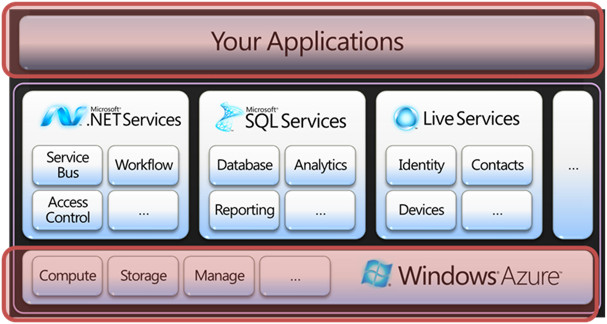
MS Azure tries to answer the move to cloud computing with virtualized computation, scalable storage, transparent management and development support. The concept is that applications will be build on top of a set of services provided by the Azure platform that will support the use of resources in the cloud like they were installed on one machine.

azure1

Development and Deployment

Azure Application Development Development for the Azure platform is done on a development fabric simulating the cloud circumstances. It is just way to complex for the moment to debug Azure applications at run-time in the cloud. Azure provides development storage for the same reasons.

It is a good idea to download the Azure Log Viewer and the Azure Storage Explorer, both third party, when you start developing: Azure Log Viewer can be found at http://blogs.itmentors.com/bill/2009/02/10/windows-azure-log-viewer/ and Azure Storage Explorer can be located under http://blogs.itmentors.com/bill/2009/02/10/windows-azure-log-viewer/

Azure Application Deployment
Applications for Azure are deployed through the Azure Services a portal hosted by MS. You upload your developed application and then the portal allows for zero-downtime upgrades or switch-deployments to bring your updated application into production. This means development and deployment for Azure consist of create-publish cycles.

Under the bonnet virtual machines are created to host your application.

System engineers are provided with status information about the application’s health through e-mail, instant messaging or phone calls.

Scalability and Availability
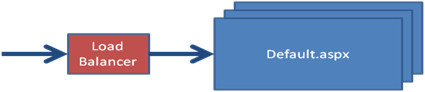
New to Azure applications is that any request in handled first by a load balancer, build-in in the platform, and then is forwarded to an instance of your application.

azure2

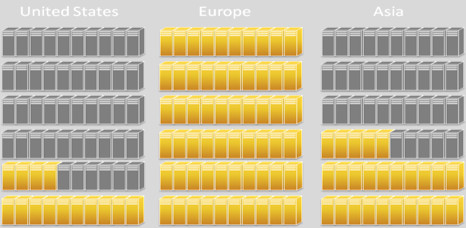
Considering scalability and availability we see that Azure really takes things further. We are not talking anymore about just a second server to have a local failover or a few machines in a datacenter to handle the load. No, we?e talking about thousands of serves in several datacenters.

The platform allows for turning-the-knob style up- and down-scaling of server capacity. It also supports dynamic capacity schemas by means of follow-the-sun server capacity. You only will have to pay for consumed resources and not for unused capacity required to handle potential peak-loads.

azure3

Storage
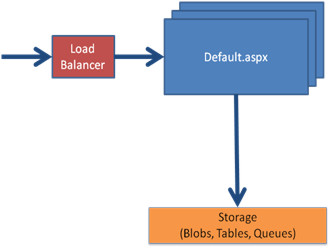
Because Azure takes control over your server instances there is no such a thing as sessions state like we are used to in, for example, IIS hosted applications. If you want some data to live longer than one request you need to use Azure Storage. All resources are logical in Azure. The platform maps them transparently to real physical resources.

Azure provides storage accessible to all instances. However there is something like Instance Storage, this should never be used to store session related data. It is just a local cache for transient data.

Azure Storage comes in three tastes ?tables (some TBs) , queues (unlimited number of messages if smaller than 8 kB ) and blobs (up to 50 GB )-and is accessible through a REST or ADO .NET Data Services interface. Data is durably stored and at least three times replicated to guarantee it is never lost.

The logical model known to the application is very simple:

azure4

For the moment there are some limitations concerning the Azure Storage. Queues only support polling instead of event based access. Applications require full trust instead off medium trust.

Azure Storage can be accessed using two roles: a web role to support synchronous HTTP requests and a worker role for asynchronous queued requests. To avoid remarks like vender-lock-in about the storage, MS made the storage accessible from outside the platform to allow you to copy data locally.

What is showing at the horizon’s
The future will bring following enhancements to Azure:

  • More types of roles (“RAW” !)
  • Mangement rules, monitoring, dynamic deployment
  • Geographic isolation, fault domains, update domains: some homeland security acts do not allow specific data to leave the country so the storage distribution must be done over datacenters within the borders.
  • SQL Data Services
Share this postSave this post

“Code Contracts, Pex and Chess” Peli de Halleux

[MS Techdays 2009] Summary “Code Contracts, Pex and Chess! Peli de Halleux”

My personal favorite of MS Techdays 2009

Introduction
The presentation was basically a walkthrough introducing three upcoming tools from MS research labs: Code Contracts, Pex and Chess.

Code Contracts
For the moment contracts and interfaces only guarantee type safety. Code Contracts framework wants to do more. The functionality will become available in .NET 4.0 through the System.Diagnostics.Contracts namespace.

Code Contracts allow for checking pre- (Contract.Requires) and post-conditions (Contract.Ensures) during development and at runtime. The functionality of checking post-conditions is really cool. A runtime rewriter will move these checks after the code were the method returns a value.

An example:

string TrimEnd(string s, string suffix) {
    Contract.Requires(s != null);
   ...

There is the possibility to put the Contacts in a different assembly and at run-time doing only light-weight checks. The tool is capable of putting the two assemblies back together.

For the moment it supports static and dynamic checking (through Pex see below). In the near future an automatic documentation generator will be added.

Pex
Pex is an automated white box testing tool for .NET. It focuses on the problem that humans are not good at creating exhaustive test cases. The tool supports parameterized unit testing. This is nothing new and already available in a lot of test frameworks. What Pex adds is a separation of concerns: humans specify the tests and test-data is generated by the tool. We are good in finding the scenario’s to test and the computer is good at creating exhaustive test-data for the test we create. Exhaustive in the sense that all code-paths are followed at least once.

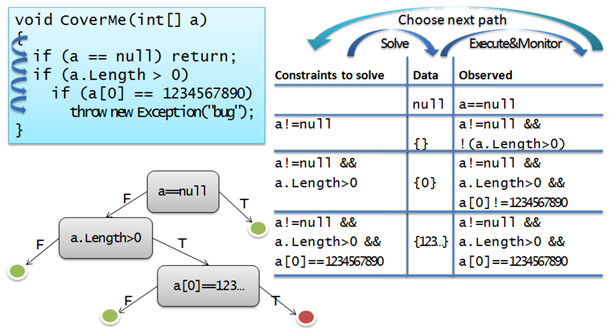
An example (see below): for the method on the left , the tool will generate for every branch it finds test-date, so every branch is covered. The first if clause imposes a condition on the variable a so we see a test appearing (in the table on the right) checking for the condition null and not null. For the not null condition the tool generates the most basic data to fulfill the case i.e. an empty array.

Pex

It is important to notice this is not boundary value analysis!

Pex is very handy for reverse engineering. It helps to build test-cases for legacy code. If you need to refactor the legacy code lather on, your effort is not lost. It is very easy to regenerate the tests.

Chess
Chess is a tool for finding and reproducing Heisenbugs in concurrent systems.

A Heisenbug (named after the Heisenberg Uncertainty Principle) is a computer bug that disappears or alters its characteristics when an attempt is made to study it. [Have a look at http://en.wikipedia.org/wiki/Unusual_software_bug for other unusual software bugs.]

Chess approaches these problems by taking over the thread scheduler to make the multithreading behavior deterministic. It creates fixed thread schedules that are added as attributes to your code. It is build upon Control Thread Scheduling (CAP) framework.

Share this postSave this post

Dropping the BOM

Dropping the BOM … Removing ‘Invalid’ characters at the beginning of a string!

Ever encountered some strange characters in a string representing an XML document you’ve just read from a file? Well you’ve forgotten to take into account the encoding that was used to write the file to disk. It is bad practice to just assume UTF-8 was used!

The strange characters are in fact the Byte Order Mark (BOM).

The BOM, sometimes called the preamble, is a set of bytes at the beginning of your document and can take up to four bytes depending on the encoding used (see list below). The BOM allows applications to correctly identify the UNICODE encoding that was used for your document.

If none of the previous doesring any bell you should really read the primer by Joel Spolsky: The Absolute Minimum Every Software Developer Absolutely, Positively Must Know About Unicode and Character Sets (No Excuses!)

Possible BOM-s:

UTF-8                  = EF BB BF 
little endion, UTF-16  = FF FE 
big endian, UTF-16     = FE FF  
little endian, UTF-32  = FF FE 00 00 
big-endian, UTF-32     = 00 00 FE FF

Below you’ll find a code example you can use to indentify and remove the characters when converting a byte array, containing an XML document, to a string.

using System.Xml;
using System.IO; 

...

public string GetMessage(byte[] message)
{
    try
    {
        /* We have a boot-strap problem here: to know the encoding of the
           message we have to look inside the message to read the document
           element of the message. So we use an XmlDocument object to find 
           the document element of the message.    */

        // Load byte[] into XmlDocument (assumes valid XML!).
        MemoryStream inputStream = new MemoryStream(message);
        XmlDocument doc = new XmlDocument();
        doc.Load(inputStream);

        // Identify the XmlDocument encoding by reading the document element.
        XmlDeclaration dcl = (XmlDeclaration)doc.FirstChild;
        Encoding enc = Encoding.GetEncoding(dcl.Encoding);
        int preambleSize = enc.GetPreamble().Length;

        /* Drop the preamble bytes if they match the encoding's preamble 
           definition.
           The preamble bytes or BOM charactes are optional so the might 
           not be there! */
        bool preambleMatches = true;
        for (int i = 0; i < preambleSize; i++)
        {
            preambleMatches = message[i] == enc.GetPreamble()[i];
            if (!preambleMatches) break;
        }

        byte[] cleanedMessage;
        if (preambleMatches)
        {
            // Remove the preamble from the message.
            cleanedMessage = new byte[message.Length - preambleSize];
            Array.Copy(message, preambleSize, cleanedMessage, 
                       0, message.Length - preambleSize);
        }
        else
        {
            // The preamble was not added to the message so nothing to remove.
            cleanedMessage = message;
        }

        return enc.GetString(cleanedMessage);
    }
    catch (Exception)
    {
        // Encoding could not be detected so we assume UTF8-encoding.
        return Encoding.UTF8.GetString(message);
    }
}
Share this postSave this post